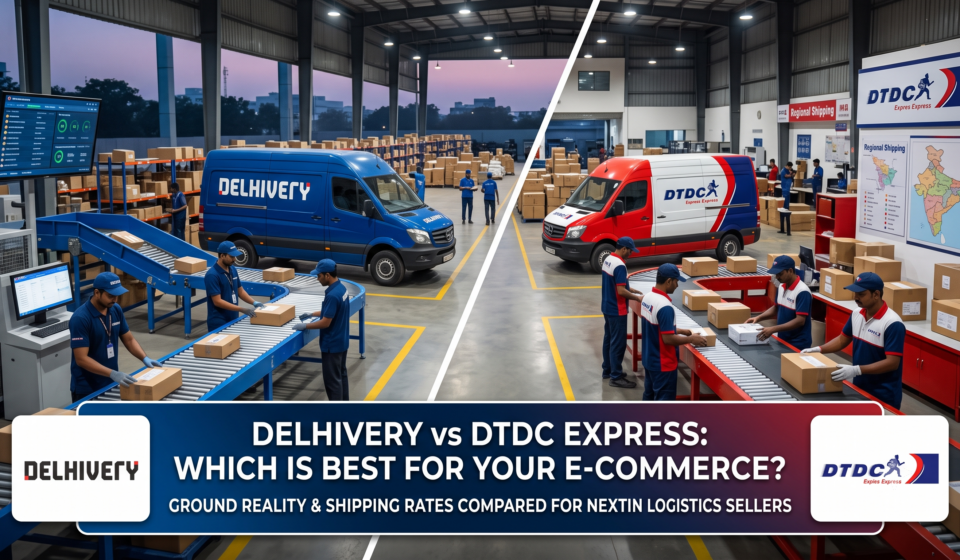
Delhivery vs DTDC Express: Ground Reality & Seller Comparison for E-Commerce in India
Published byRishi Kumar. Last updated July 29, 2026. Courier Partner. 6 min read
Choosing the right courier partner is one of the most critical operational decisions for an e-commerce business in India. A delayed shipment, a mismanaged Cash on Delivery (COD) order, or a high Return-to-Origin (RTO) rate directly affects your profit margins and brand reputation.
While market marketing claims promise seamless nationwide delivery, the ground reality of how logistics operations run often tells a different story. In this deep dive, we compare two major Indian logistics powerhouses—Delhivery and DTDC Express—focusing on actual operational mechanics, true pricing models, tech integrations, and COD remittance cycles.
Operational Architecture: How They Work on the Ground
To understand performance differences, you first need to understand how each network is structured internally.
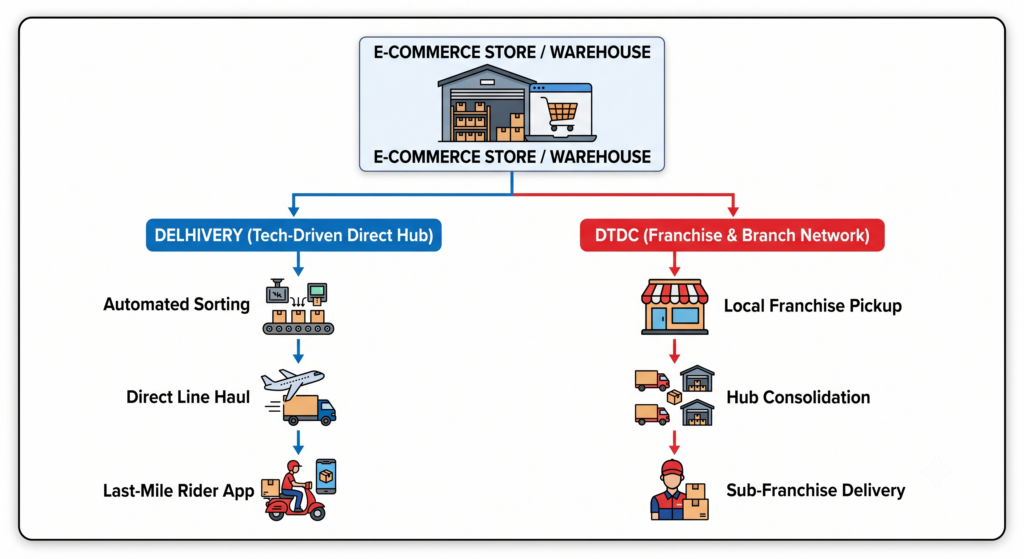
1. Delhivery (Direct Hub & Automated Tech Network)
- Model: Primarily operates through company-owned or directly managed hubs, automated sorting centers, and tech-enabled last-mile delivery partners.
- Ground Reality: High reliance on automated sorting belts and algorithm-based route optimization. This leads to faster processing in Tier 1 & Tier 2 cities, but can cause customer service deadlocks when manual intervention is needed at local hubs.
2. DTDC Express (Franchise & Regional Channel Network)
- Model: Relies heavily on a massive franchisee network spread across urban and rural India.
- Ground Reality: Exceptional reach into Tier 3, Tier 4, and deep pin codes. However, service consistency varies drastically from one local franchisee owner to another. A bad franchisee in a specific region can result in high fake delivery attempts.
Pricing Reality: Surface Rates, Hidden Charges & Volumetric Calculations
Many logistics providers advertise attractive base rates per 500 grams, but the invoice amount often includes several additional operational charges:
- Volumetric Weight Formula: $\text{Length} \times \text{Width} \times \text{Height (in cm)} / 5000$ (Charged on whichever is higher: Dead Weight or Volumetric Weight).
- Fuel Surcharge (FSC): Varies dynamically between 10% to 18% over base rates.
- COD Charges: Fixed fee (₹30–₹50) or 1.5%–2.5% of parcel order value, whichever is higher.
- RTO Charges: If a package is rejected, the seller pays Forward Freight + Return Freight (often 1.5x to 2x the standard rate).
Rate Comparison Table (Estimated Standard Surface Commercial Rates)

5-Point Deep-Dive Comparison
1. Delivery Velocity & Speed
- Delhivery: Offers direct Air & Surface lines. Direct fulfillment options allow guaranteed 24-48 hour deliveries in top metro routes.
- DTDC: Offers “Plus” and “Priority” express services for time-critical orders, though standard ground shipping (DotZot / Ground Express) usually takes 3–6 business days.
2. Non-Delivery Report (NDR) & Fake Attempt Management
- Delhivery: Automatically triggers SMS/WhatsApp buyer verification links when an attempt fails (e.g., “Customer Unreachable”). This reduces fake non-delivery reports significantly if automated promptly.
- DTDC: Often relies on local franchise delivery boys logging status updates manually. Communication during NDR can be slower, leading to higher RTO percentages if not tracked actively.
3. COD Remittance & Cash Flow
- Delhivery: Standard COD remittance cycle is D+4 to D+7 days after successful delivery. Early COD remittance plans are available via aggregators for an additional fee.
- DTDC: COD reconciliation passes through local regional offices to central accounts. Remittance can take 7 to 12 business days, making cash flow management tighter for small D2C brands.
4. API Integration & Dashboard Usability
- Delhivery: Provides robust REST APIs, Shopify/WooCommerce apps, and automated shipping label generation. Real-time webhook updates keep customer communication smooth.
- DTDC: Has improved its e-portal and APIs, but integrating legacy franchise systems with modern web storefronts can occasionally show delayed tracking milestones.
5. Customer Service & Issue Resolution
- Delhivery: Support is strictly ticket-based via their enterprise panel. Getting a human account manager usually requires high monthly order volumes.
- DTDC: Allows sellers to contact local branch managers or regional center heads directly, which can be useful if you build a good personal relationship with your pickup franchisee.
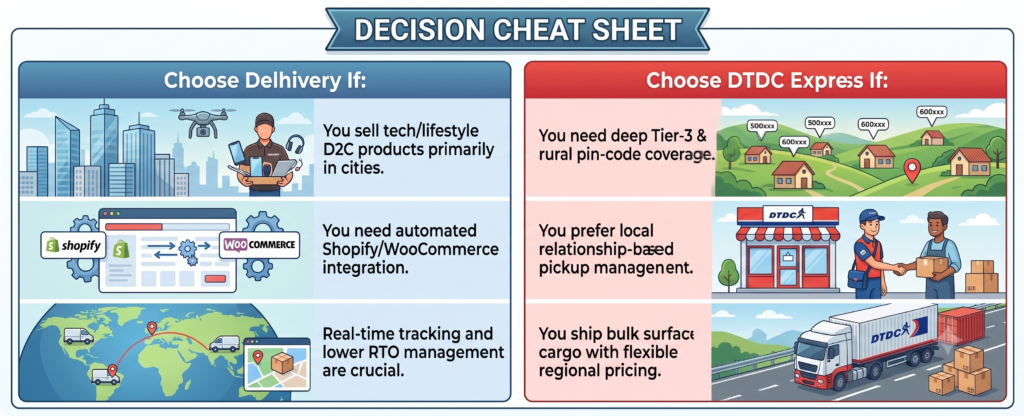
Summary Matrix: Which One Should You Choose?
The Smarter Alternative: Why Rely on Just One?
Relying on a single courier carrier leaves your business vulnerable to local hub backlogs, regional strikes, or sudden service outages.
With Nextin Logistics, you don’t have to choose between Delhivery, DTDC, or other top carriers. Our Smart Smart-Routing AI automatically allocates every shipment to the best-performing courier partner based on pin-code delivery success rates, cost, and speed.
What You Get with Nextin Logistics:
- 10+ Carrier Options (Delhivery, EKart, Xpressbees, and more) on one dashboard.
- Unified COD Remittance in as little as 2 days.
- Auto NDR Management to cut RTO rates by up to 30%.
- Single Dedicated Account Manager for all shipment disputes and claims.

Frequently Asked Questions (FAQs)
Q1. What happens if a shipment is lost in transit?
- Delhivery: Standard liability claims require submission within specified SLAs, capped according to agreed terms unless declared value insurance is purchased.
- DTDC: Provides a Certificate of Facts (COF) upon request for insurance claims, subject to administrative charges and policy terms.
Q2. How is volumetric weight calculated for bulky items? Both courier partners use the standard industry formula: ({L} x {W} x {H in cm}) / 5000. Always measure the final packed box dimensions (including outer padding) to avoid unexpected weight discrepancy charges on your bill.
Q3. Can I use both Delhivery and DTDC for my e-commerce store? Yes. Using a multi-courier shipping platform like Nextin Logistics enables you to auto-switch between Delhivery for fast metro orders and DTDC for deep interior pin codes from a single dashboard.